Urban Aquifer: Vehicles to Think With
Lesley Gamble
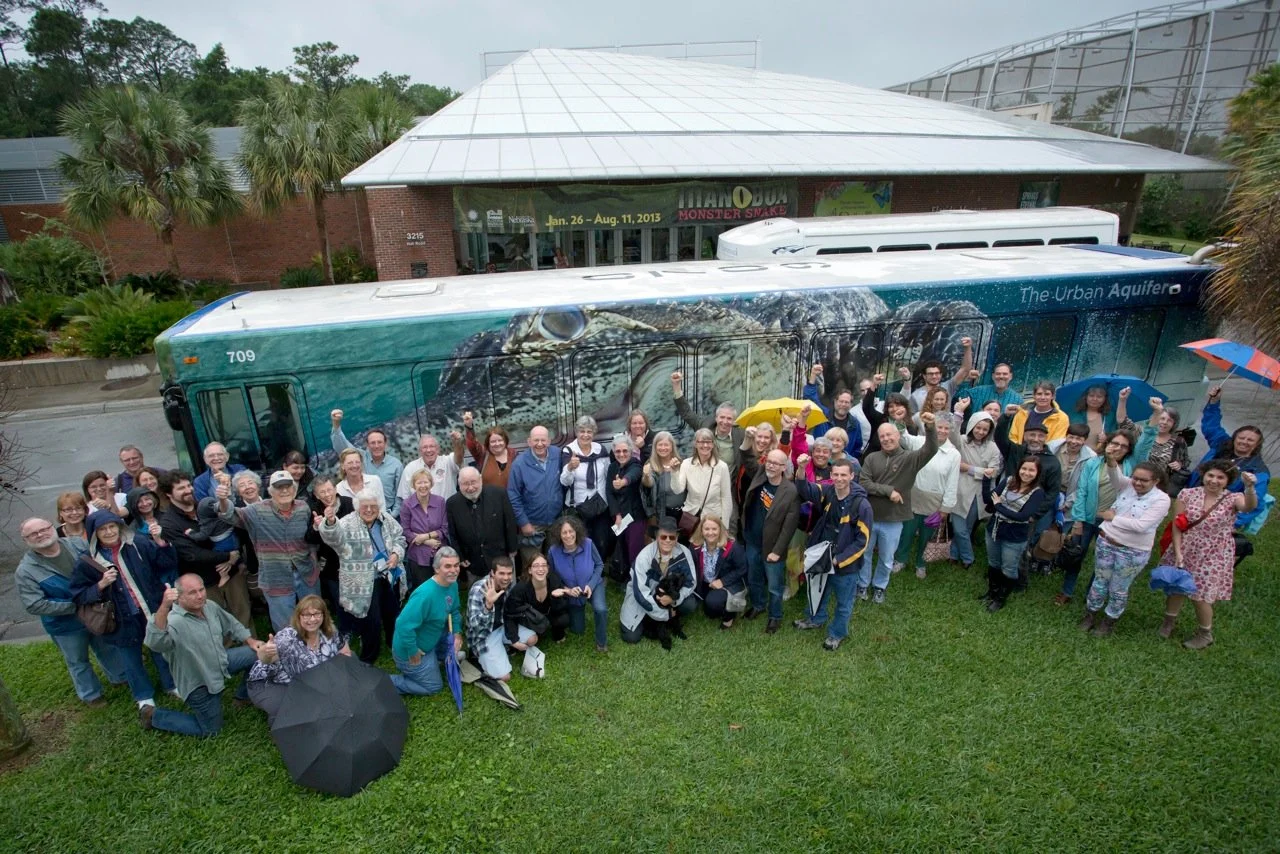
Lesley Gamble’s URBAN AQUIFER debuts at the Florida Museum of Natural History, April 2012
Springs featured in the Springs Eternal Project travel far beyond the walls of a museum, streaming through the virtual space of the Internet as well as the concrete highways and byways of Gainesville. Windows onto the aquifer, the springs make visible our essential connections to water and to each other.
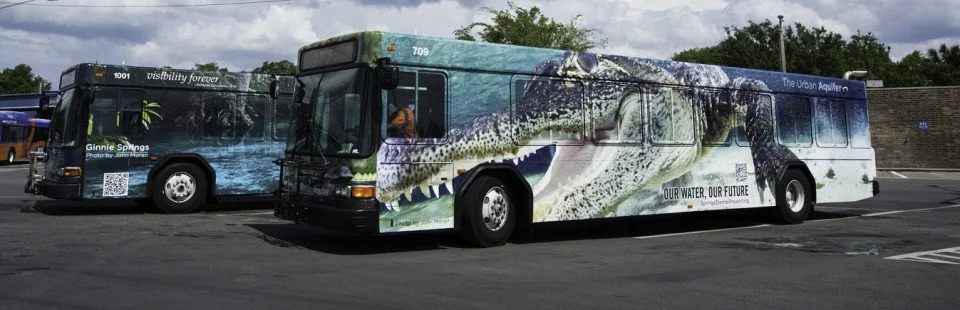
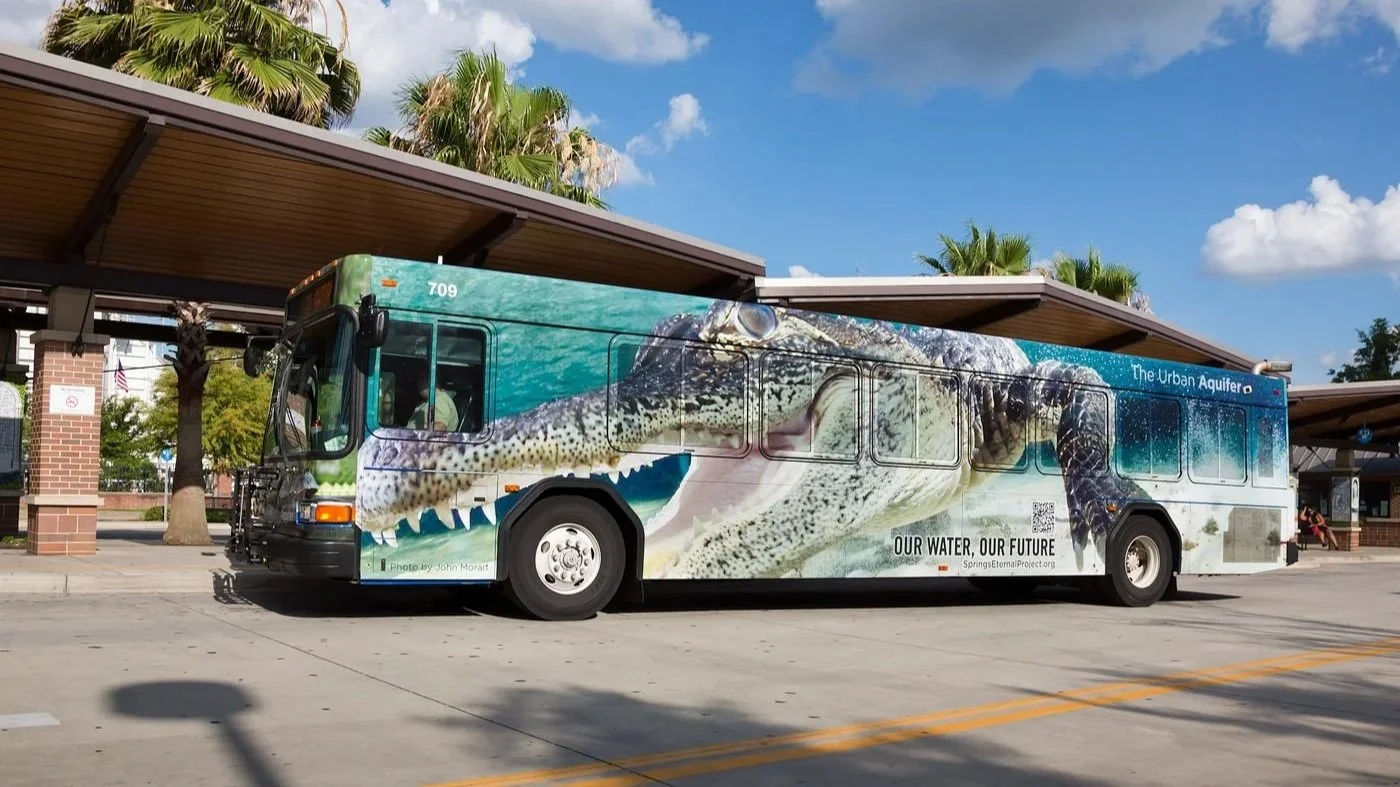
Urban Aquifer: Vehicles to Think With, created by Springs Eternal Project Co-Director Lesley Gamble, is a performance artwork, concrete poem, mobile educator and ongoing public service event that “daylights” the aquifer beneath our feet. Wrapped in luminous full-scale springs images created by local artists Margaret Ross Tolbert, John Moran, Tom Morris and Mark Long, Regional Transit System buses flow throughout our urban conduits as a metaphoric aquifer, the lifeblood of our region.
Urban Aquifer: Vehicles To Think With
Urban Aquifer: Vehicles To Think With follows a public art initiative in Gainesville, Florida, where city buses are wrapped in luminous images of springs. Through interviews, community collaboration, and moving imagery, the project invites viewers to recognize their connection to Florida’s aquifer and the impact of everyday actions on these fragile ecosystems.
-
Full Video Description & Transcript
The video begins with a black screen displaying text:
“City buses wrapped in luminous large-scale images of springs have been flowing through the streets of Gainesville, Florida.”
The next black screen reads:
“Created by Lesley Gamble, the Urban Aquifer project inspires Floridians to celebrate, restore and protect Florida's freshwater treasures, our magnificent springs and aquifer.”
A third black screen displays the title:
“Urban Aquifer: Vehicles To Think With.”
A white hand icon with a pointing finger appears and clicks the title. The video begins.
A man speaks with the sound of a bus in the background. He is later identified on screen as:
“Tom Morris, photographer, cave diver, biologist.”
He says:
“Yeah, I'm Tom Morris, I'm a local around here and I've been hangin' out at the springs ever since I was a kid… so I have a keen interest in the springs. And these gals kinda roped me into this project, and that's the end result.”
He gestures toward a city bus wrapped with large images of springs.
He continues:
“It’s the bus with this beautiful spring image on the side of it… the whole idea is to give these springs as much press as we can get them.”
The bus is shown driving away. Music begins.
A montage shows close-up details of the bus wrap. The back of the bus displays the text:
“Our Springs, Our Future”
with a QR code beneath it.
The scene shifts inside the bus, showing the driver reflected in a mirror, then the driver directly. The camera then shows a view through the window of a park landscape passing by.
On-screen text identifies the driver:
“Tom Idoyaga, Gainesville Regional Transit System.”
He says:
“This is one of those examples where a public entity like RTS and a private [group] get together and collaborate on something that works for both parts… it’s a win-win situation.”
The scene cuts to a blonde woman wearing sunglasses standing in front of a bus across the street. On-screen text reads:
“Lesley Gamble, Creator of the Urban Aquifer.”
She says:
“Well I see the urban aquifers as a kind of public service art installation… mobile concrete poetry.”
The video cuts to multiple buses, including one labeled “21 Cabana Beach.”
She continues:
“When I see an Urban Aquifer bus, it’s always a moment when I think, ‘oh this is beautiful, or surprising, or whimsical or magical.’ It’s like the spring just pops here in the middle of town.”
The visuals shift to students reviewing design plans, then painting buses. A student holds a cup of blue paint and a brush. Children are shown inside and around a bus with a teacher.
Text appears referencing:
“Rural Aquifer collaboration with aquiPROJECT, the White Springs H.O.P.E. Program and the Urban Aquifer.”
Lesley Gamble continues speaking:
“I want people to realize that the aquifer is under our feet all the time… everything that we do here in Gainesville actually affects the springs there on the Santa Fe River.”
Visuals show lawns, houses, and agricultural spraying, followed by underwater footage of springs.
She continues:
“Especially land use, fertilizers, pesticides on our lawns, the way in which we use and conserve water… all of this affects the springs.”
Images show algae-covered water, a kayaker, and a person tubing with algae visible.
She concludes:
“So even if you live far from the spring, everything you do here affects the springs.”
A woman appears on screen, identified as:
“Margaret Ross Tolbert, Artist.”
She says:
“You may have never seen Sirena because she is rarely seen.”
Images show a woman underwater in a pink dress and high heels.
“She is only in really pristine waters… that’s where she survives, like many species.”
More underwater imagery appears.
“Any threats to the springs would destroy Sirena… we don’t know our folklore of the spring. So I like to think as an artist that she’s part of the mythology.”
The video returns briefly to her interview, then shows a bus wrapped with her imagery.
The scene returns to Tom Idoyaga driving the bus. He says:
“When we stop downtown… people just kept looking at them like it was kind of novel… they were proud that this is something from our area… our passengers, passersby, local traffic look at it like it’s something special. Which it is.”
The video shows buses driving through the city, including close-ups of the text:
“Our Springs, Our Future”
and the website:
“springseternalproject.org”
A white hand icon clicks the website text. The screen ripples like water and transitions to underwater footage of springs.
A montage follows:
aquatic grasses underwater
people swimming
a child in the springs
snorkeling footage
a manatee swimming
a kayaker paddling away
children playing at the shoreline
an orchestral performance with a projected manatee image
a public speaking event
protest scenes with flags and signs
the Springs Eternal exhibition
a billboard reading “Save Our Springs – springsforever.org”
children swimming and jumping into the springs
a group photo in front of a bus
The video ends with underwater footage and the text:
“TAKE ACTION NOW
Save our Springs, Save Our Aquifer
To find out how, visit our TAKE ACTION page at:
http://springseternalproject.org/take-action-now/
or follow the Urban Aquifer QR codes”Gentle water sounds play as fish swim.
Credits appear:
“The Urban Aquifer created by: Lesley Gamble
Co-Director of the Springs Eternal Project”“Contributing Artists: Mark Long, Tom Morris, John Moran, Margaret Ross Tolbert, Sirena”
“Additional Photography by: Lesley Gamble, John Moran”
“Special thanks to the Rural Aquifer: Tracy Wyman of aquiPROJECT and the White Springs H.O.P.E. Program students in collaboration with Lesley Gamble’s Urban Aquifer”
“Special Thanks to: Gainesville Regional Transit System (RTS), Gainesville Florida, Theresa Harrison, Chip Skinner, Tom Idoyaga, Ginnie Springs Outdoors, Blue Springs Park, Alachua Conservation Trust”
“Video by: Eric Flagg
Additional Footage by: Isaac Brown, Eric Flagg, Ana Habib
www.jellyfishsmack.com
2015”“Music by: Josh Woodward
www.joshwoodward.com”The video ends on a black screen with text:
“The Springs Eternal Project is an affiliate of Alachua Conservation Trust”
Alachua Conservation Trust logo appear along with:
“SpringsEternalProject.org
AlachuaConservationTrust.org”
Each bus depicts one of our Florida springs, described by William Bartram as “the blue ether of another world”—surprising, dramatic, radiant. While the aesthetic appeal of this moving artwork implies poetry, actual phrases culled from historical and literary references float suspended across the aqueous imagery.
One bus conveys “hidden in the prisms of cerulean light,” a fragment of poetry penned by Tolbert, while another cites Jacques Cousteau’s description of Ginnie Springs’ astonishing clarity in 1974: “visibility forever.”
Urban Aquifer SIRENA bus, a collaboration with artist Margaret Ross Tolbert, photographer Tom Morris and Lesley Gamble.
Together, the circulating buses create chance grammars, spurring observational games and a sense of playful delight. Phrases, like people, meet, pass, and continue on to their various destinations, small poems springing up in unlikely places
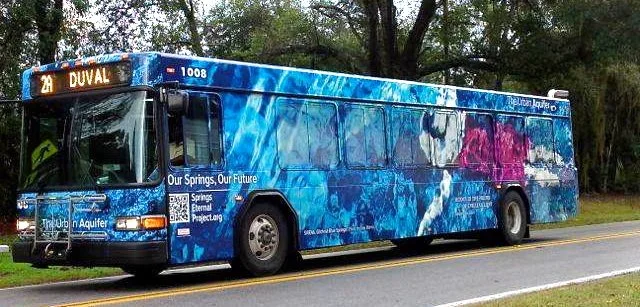
Urban Aquifer SIRENA bus, a collaboration with artist Margaret Ross Tolbert, photographer Tom Morris and Lesley Gamble.
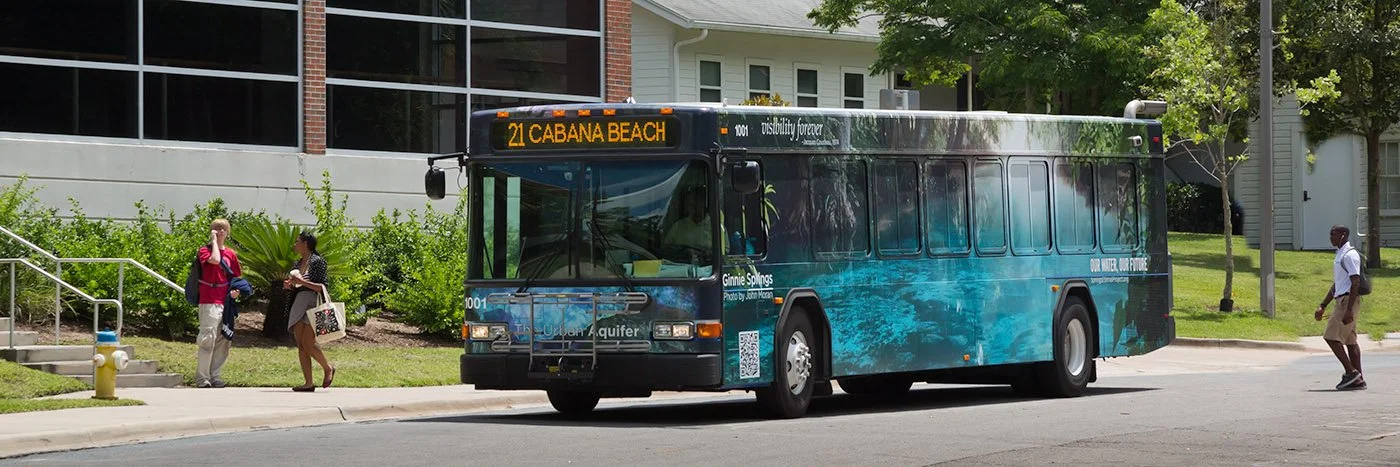
Urban Aquifer Ginnie Springs bus sighting! Sponsored by Ginnie Springs Outdoors.
The health and beauty of our springs depend on everyone’s water habits and land use practices, even if we live some distance from an actual spring. The Floridan aquifer that feeds our unique and precious springs is not an infinite resource but a finite ecosystem. Like RTS, it’s a dynamic system of transportation, storage and routing highly sensitive to loads and cyclic changes. Both require sustained public support and investment, wise management, a long-term view, and a healthy balance of inflow and outflow to function optimally.
QR matrix barcodes printed on each bus link viewers directly to the SpringsEternalProject.org website, which offers a wealth of information and resources on springs. Here, you can explore springs history, culture, science, art and public policy. Access the stories, experience and wisdom of a diverse group of people, from biologists, hydrogeologists and environmental scientists to cave divers, artists, business owners and advocates– all people who know and love their springs. You’ll discover why these springs are worth protecting and the actions we can take, individually and collectively, to restore our springs and aquifer to clear, vibrant and sustainable health. Please see our TAKE ACTION page to learn what you can do right now.
Urban Aquifer meets people where they live in the course of their daily lives, reaching out in particular to those who may never have visited a museum or a spring. Visually compelling, it offers an effective means to capture people’s attention, provoke questions and delight, and provide access to more comprehensive information about our springs.
Whether you are riding a bus or just happen to see a “bowl of liquid light” glide by, you can enjoy the aesthetic, satisfy your curiosity about its origin, and learn more about the waters that nourish and sustain us.
Dr. Gamble teaches art history at the University of Florida. Her Art, Water and Ecology course focuses on our local springs as an important case study for researching relationships between art, science and public policy.
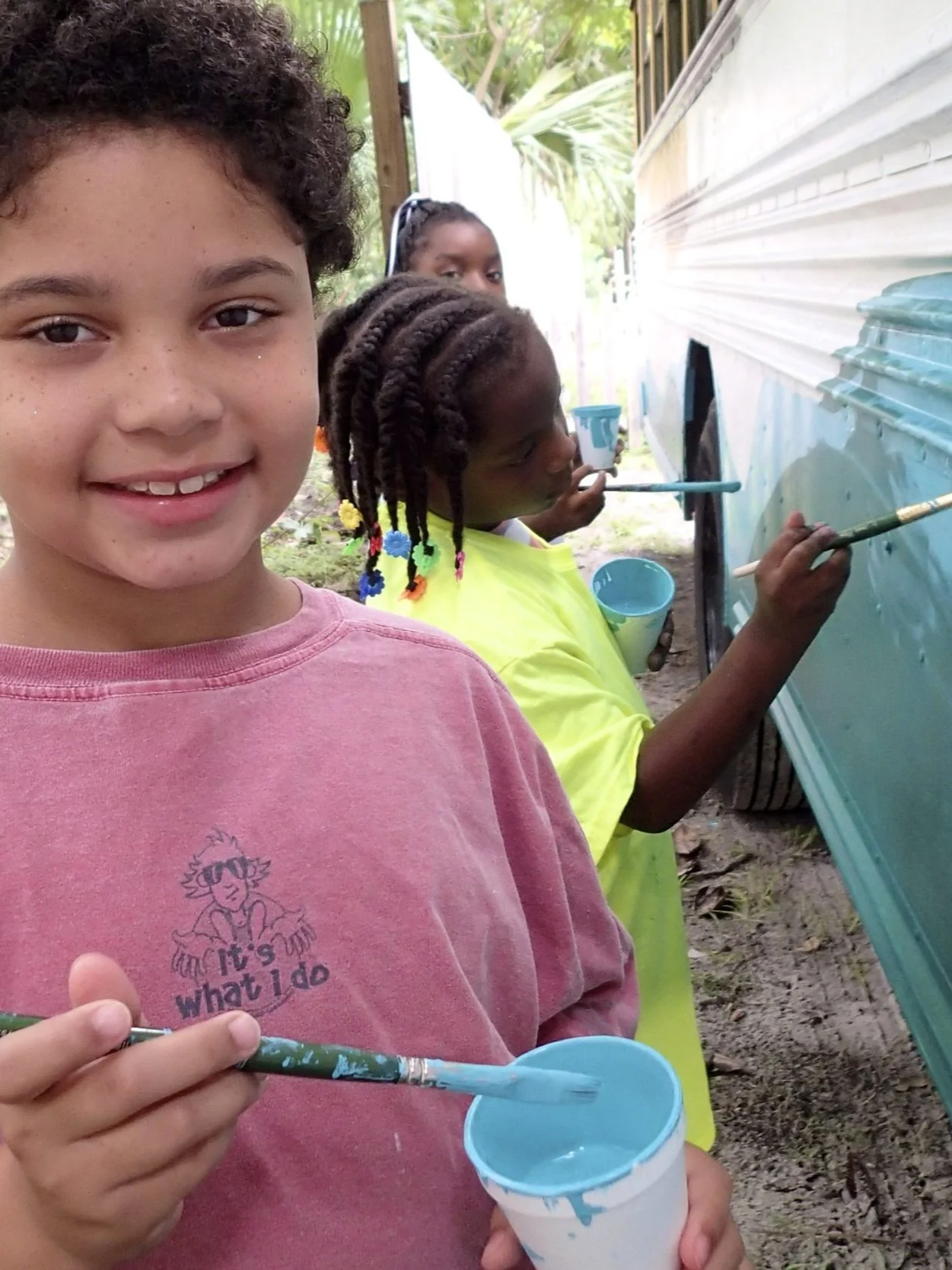
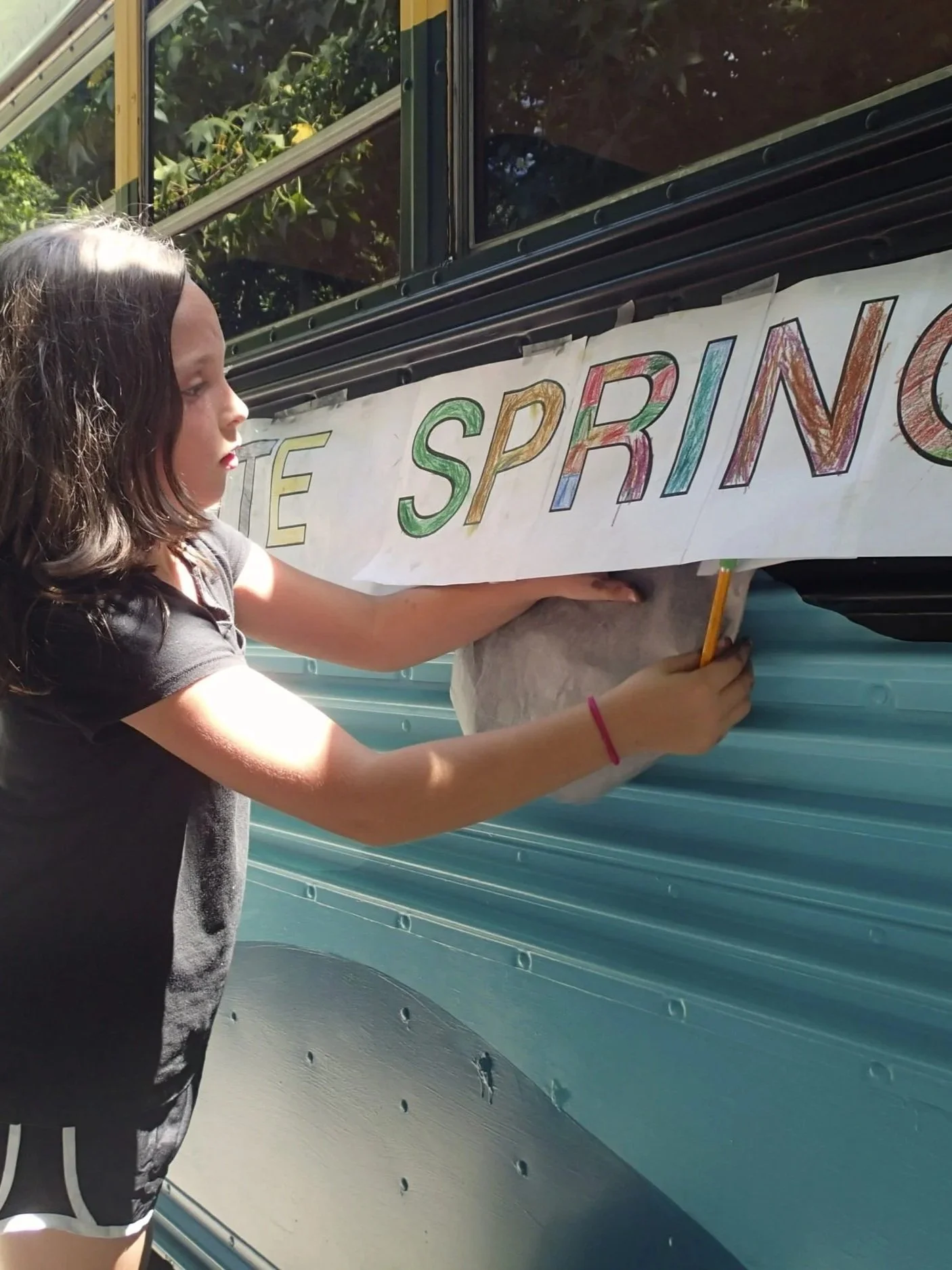
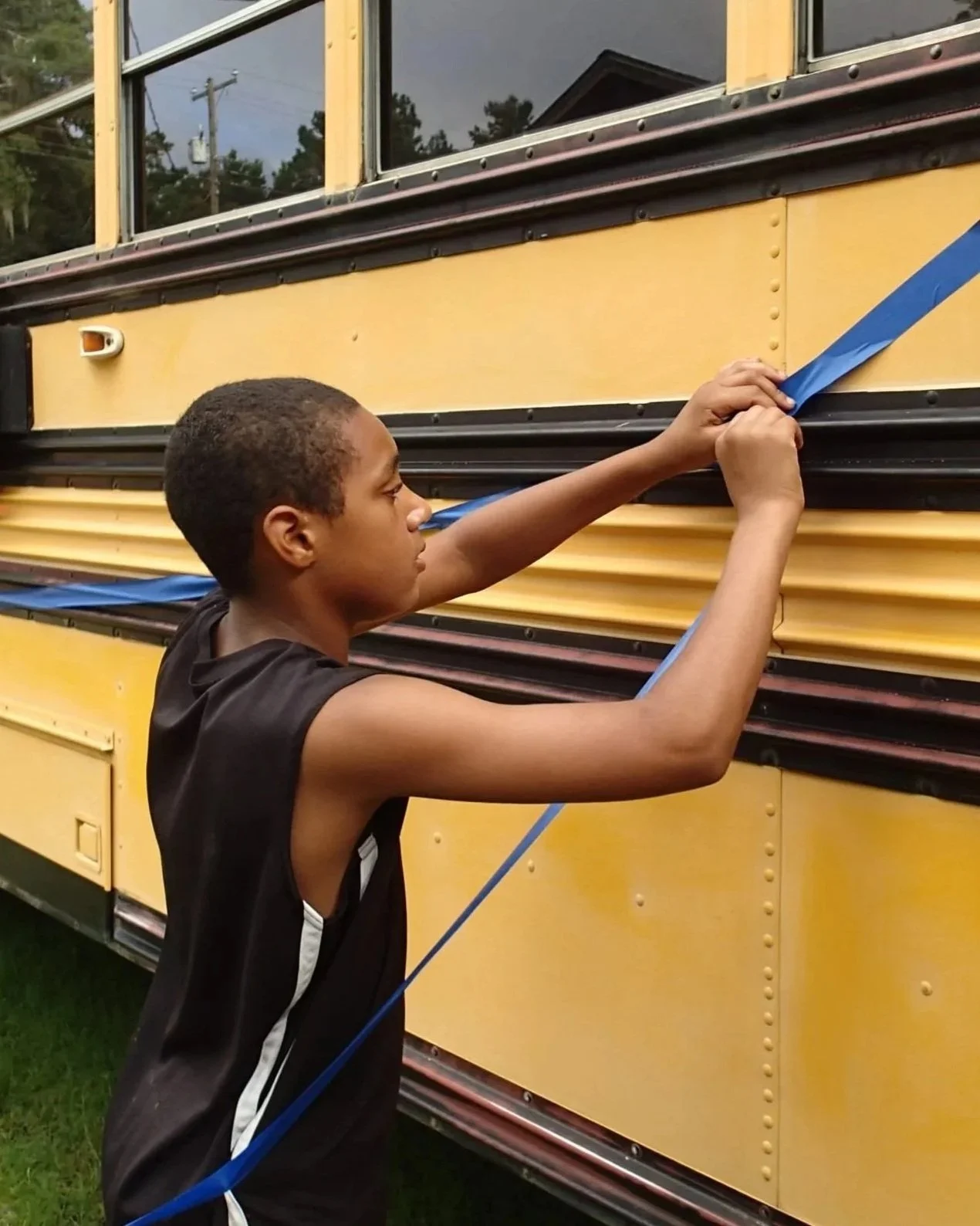
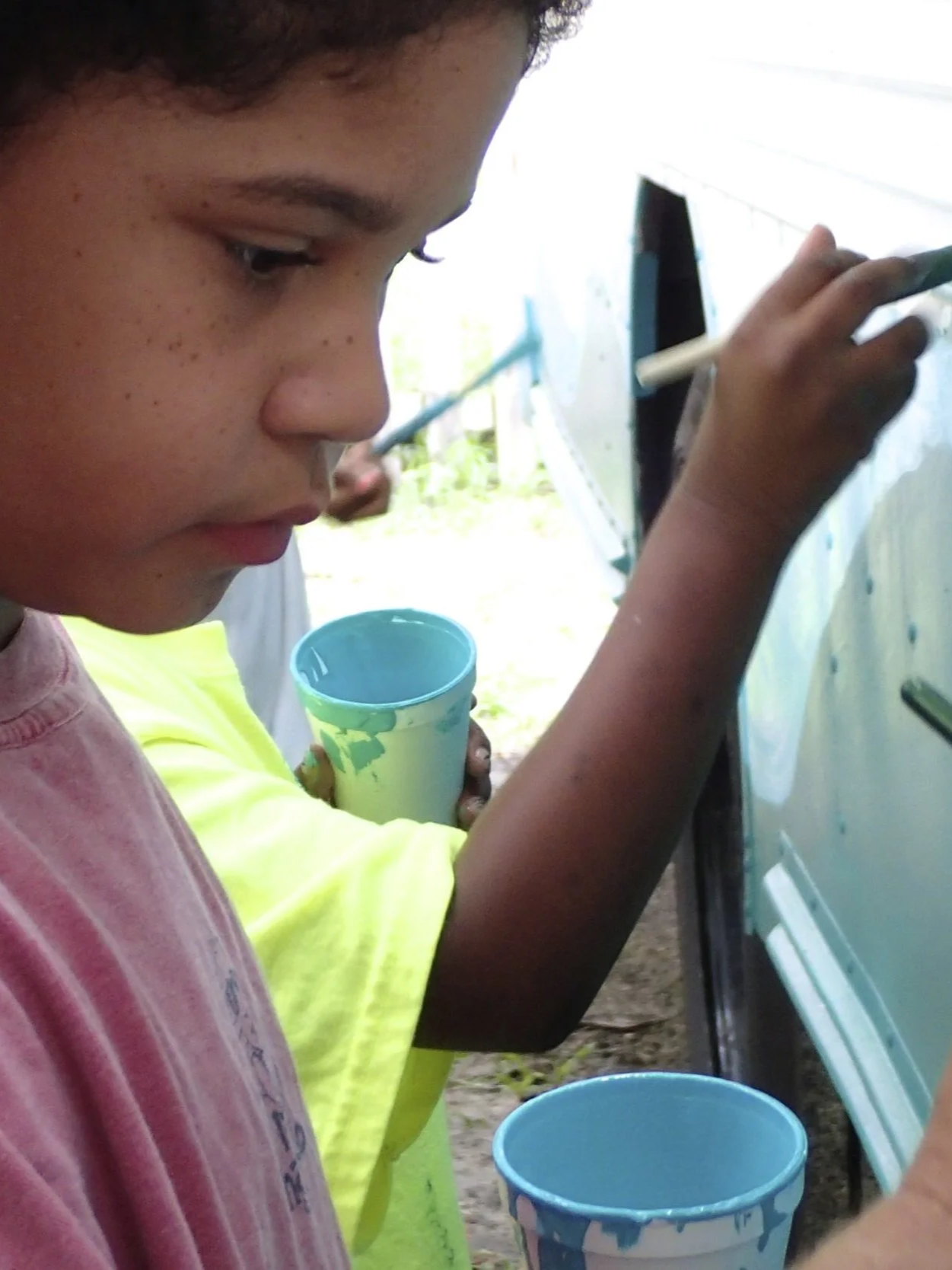
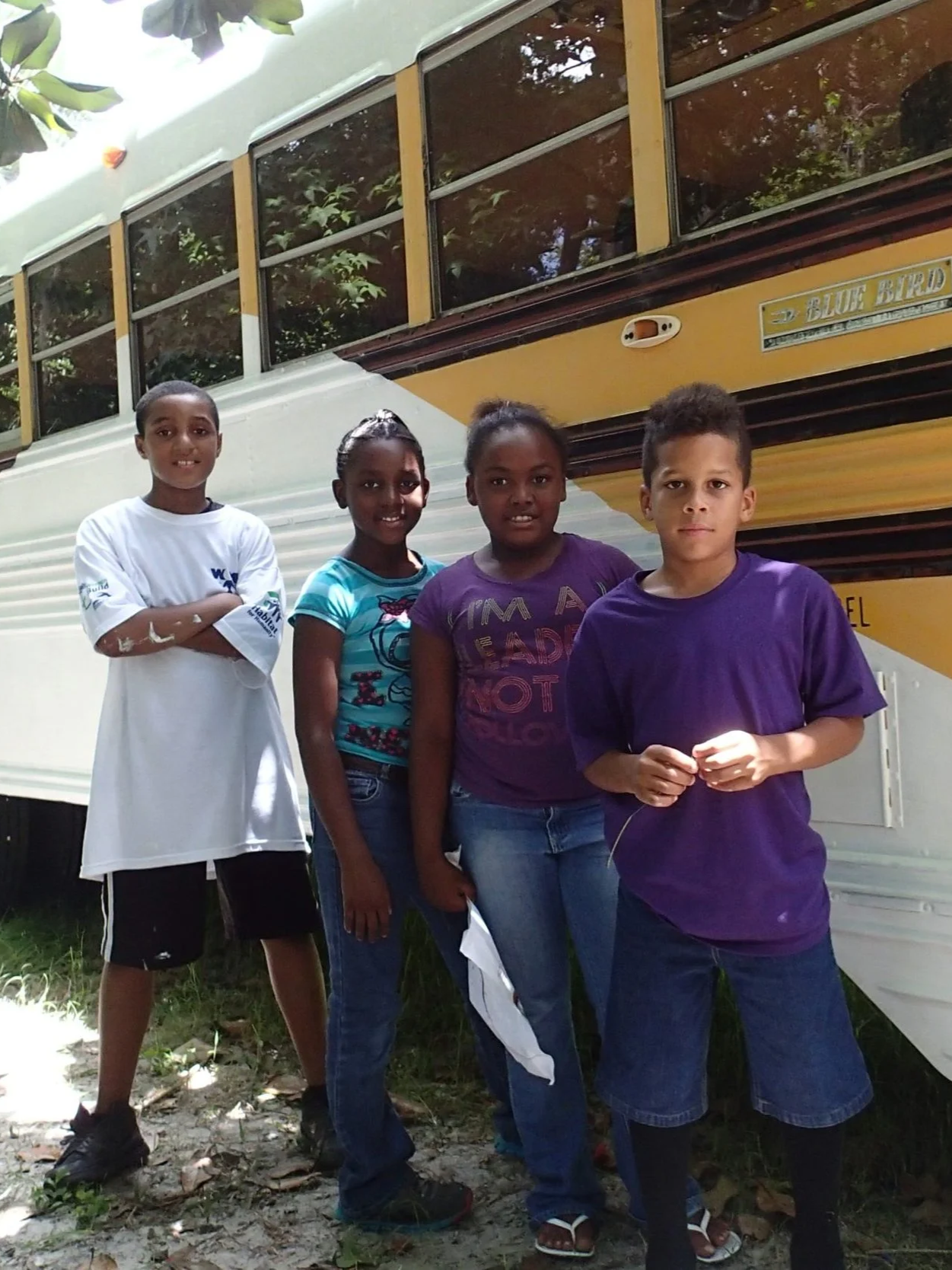
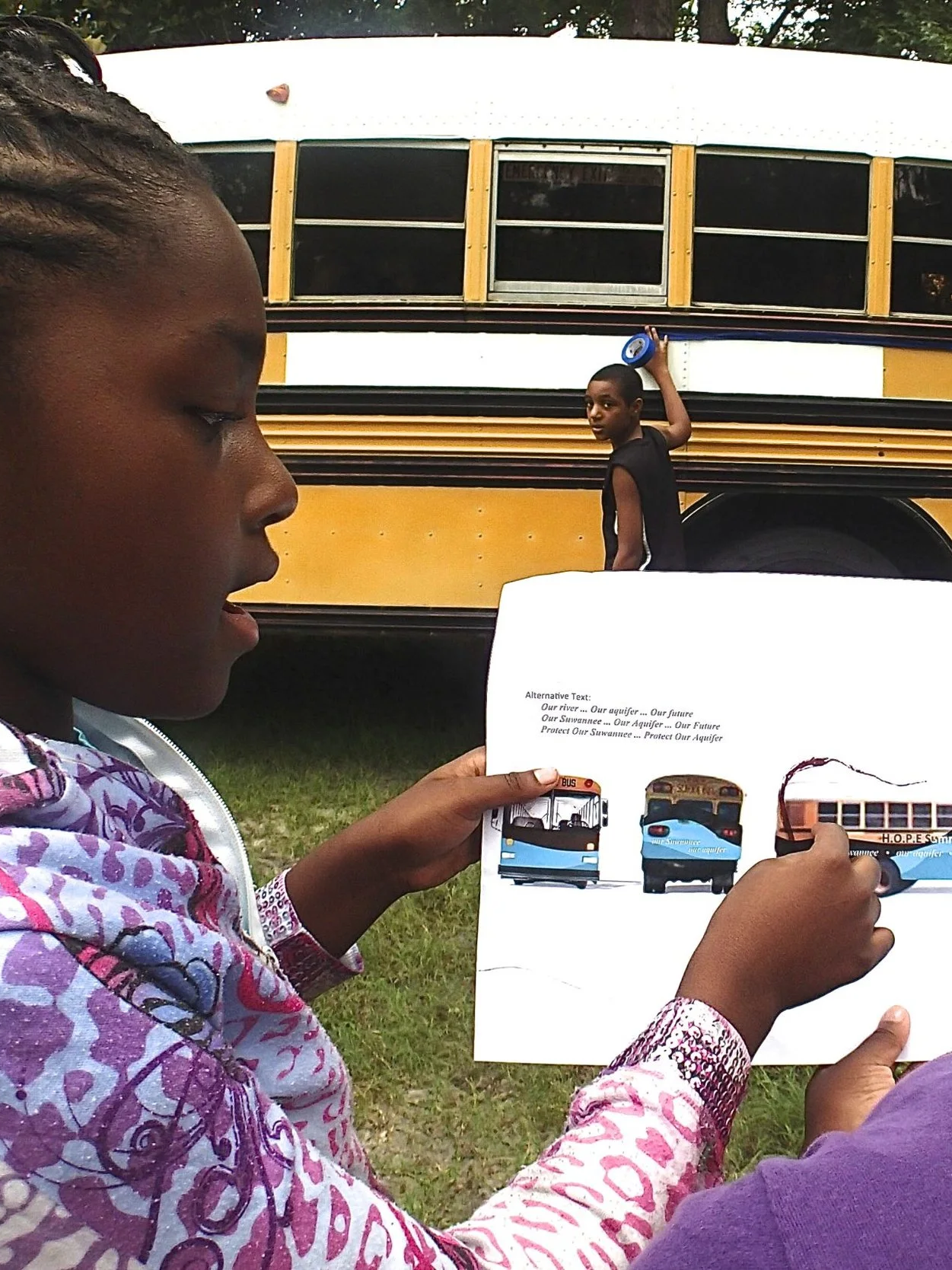
Urban Aquifer has a new relation! The Rural Aquifer bus was created in collaboration with Tracy Wyman’s aquiPROJECT and children enrolled in the White Springs H.O.P.E. Program.
To find out what the kids have to say, click here: Rural Aquifer
We love Tracy Wyman’s aquiPROJECT. Here’s a pdf of her poster for the summer 2013 collaboration with the White Springs H.O.P.E. Program and Lesley Gamble’s Urban Aquifer:
The students were involved with every step of the transformation.
Partnership and Outreach:
The Rural Aquifer
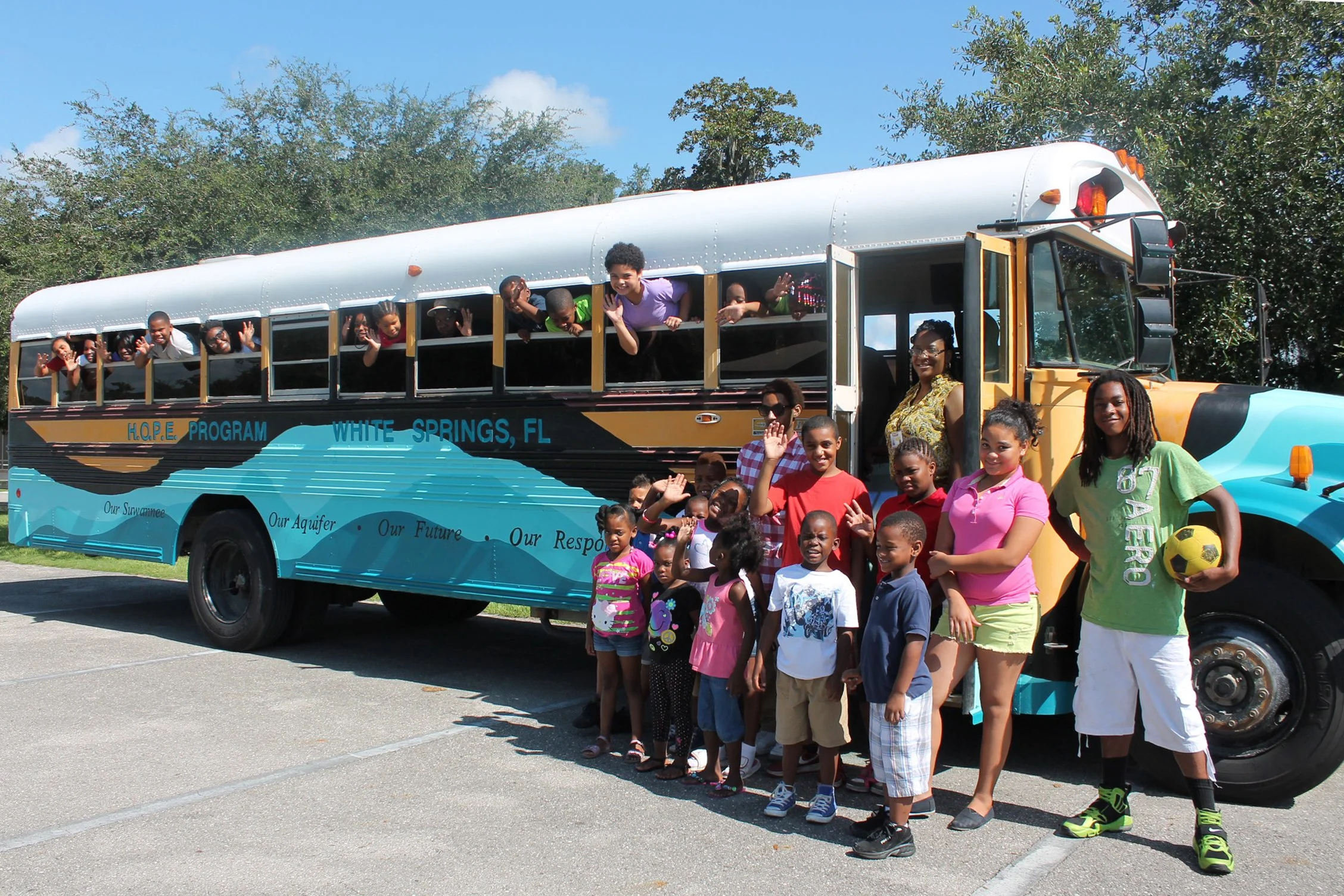
Photos by Lesley Gamble