Take Action Now
6: Be A Springs Citizen
6.
Call for Responsible Water Planning, Management and Environmental Protection
The sources of our water problems—reduced flows and pollution— have been understood for years. Although some recent studies have clarified the division of responsibility, there are no pending actions by state government or water management districts that provide effective, measurable solutions to these problems on a statewide basis.
Legislation is needed in the 2014 session to protect our waters, our environment and our economy.[4] To stay up to date on legislative issues, join the Florida Conservation Coalition. Here are some Talking Points on the proposed Simmons Bill assembled by the Howard T. Odum Florida Springs Institute.
We must call on our Florida legislators, the Florida DEP and our Water Management Districts to abide by and enforce the environmental protection laws already on the books, such as OFW (Outstanding Florida Waters designation). We must also insist that these agencies, which we support with our tax dollars, provide the necessary planning, regulation and management required to restore our springs and aquifer to health now. Time is running out but this can be done.
A state-wide Springs Initiative is needed that includes routine springs monitoring and health assessments, strict enforcement of existing laws to protect springs, and adequate public funding for springs protection and restoration. To stay current with these issues, join the Howard T. Odum Florida Springs Institute.
Local governments must be able to protect springs. One of the easiest things the Florida legislature could do is to remove the many pre-emptions they have created over the years that limit local governments. Local government’s ability to regulate septic tanks, agricultural practices, building codes, etc. have been pre-empted, as has local government’s ability to tax or license certain products or activities. This is where the legislature could, with minimal fiscal impact to state coffers, unshackle local government to seek solutions that won’t work at the state level.
In addition, springs legislation could include a general section clearly stating that: “no act of the legislature shall constrain a local government from enacting and enforcing rules consistent with state water quality standards to control pollution sources.”

The Springs Eternal Project’s first exhibition tour for policy makers. Dr. Bob Knight, Representative Clovis Watson, Jr., Springs Eternal Project Co-Directors Lesley Gamble and John Moran
Here are Some Direct Actions:
Adopt and Educate a Legislator. Show lawmakers that there are more Floridians who care about Florida’s water and land than about the next strip mall. Tell them so all year. If they respond with active commitment to finding effective and timely solutions, support them at election time.
Contact your Representatives. Ask them: What is your plan to clean up our springs? Thank legislators who do respond. Vote for those who know the issues and are actively working with local springs groups to find sustainable solutions. To contact your Senator, click here. To contact your Representative, click here.
Contact your Florida Department of Environmental Protection (DEP) about water quality issues, including the massive outbreaks of algae choking our springs and coastal waters alike.
Contact your Florida Water Management District and attend meetings. Send them your comments about pending water permits and other water issues.
Issues to Address with Legislators & Government Agencies:
The kind of prudent and responsible water management we need cannot occur without an accurate picturethat tells us how much water is being used by whom, when and for what purposes. Laws and regulations must be enforced.
This is what we need:
-
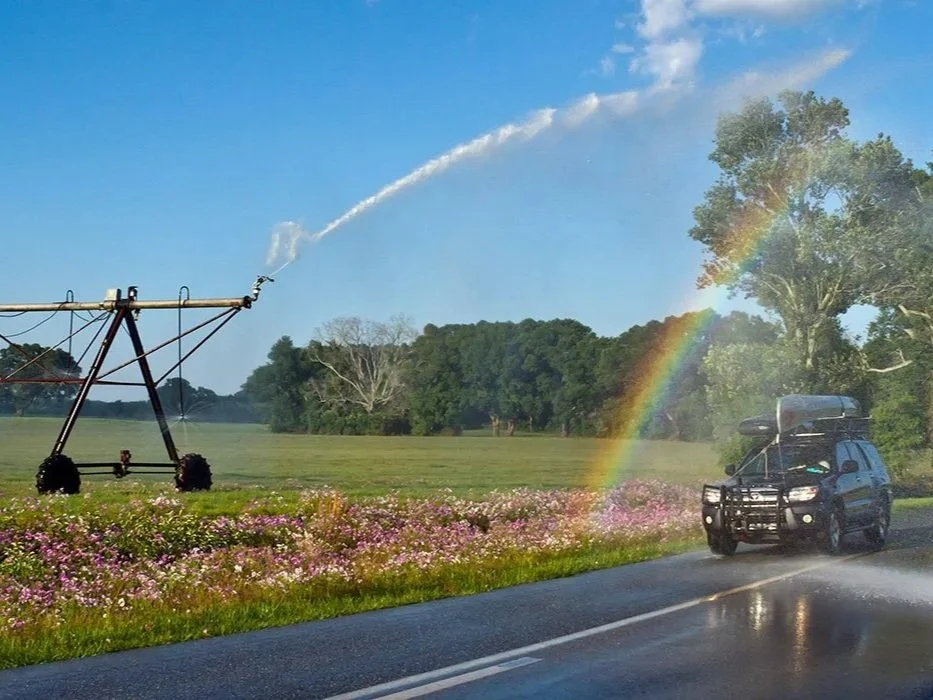
A FLORIDA WATER BUDGET that accurately assesses the amount of water flowing out of natural systems in relation to the amount coming in through recharge and rain. We need to adopt water budgets for each springshed, water management district, and for the entire Floridan aquifer. These water budgets need to limit human use of water from the aquifer so as to maintain 90% of historic spring flow.
This requires:
–Mandatory metering of all wells, including agricultural wells, which are currently exempt (on a voluntary basis only).
–Accurate Water Models that reflect our karst-based aquifer and understand surface water and groundwater as interrelated in our hydrogeological system. Currently our WMDs (Water Management Districts) and the FL DEP (Department of Environmental Protection) use computer models that do not reflect the reality of how water moves through the karst system. Their models are primarily “static” models that make calculations as if water were moving through sand, which, as any cave diver knows, is not the case in our karst geology. Instead, the USGS (United Sates Geological Survey) recommends “transient” models that take into account the realities and impacts of water moving through large and small conduits, where it travels much faster and pollutants move more quickly.
There is, in fact, a far better water model available, one already developed, tested and implemented in the Santa Fe springshed by Dr. Todd Kincaid. By taking the conduits and hydrogeology of the karst system into account, Dr. Kincaid’s model can more accurately assess how-and how quickly-water travels through the system, which gives crucial information about the impact of groundwater withdrawals on the aquifer. This information is important for calculating recharge, pollution and the potential development of sinkholes, and should be a primary source of data whenever WMDs consider issuing permits for water withdrawals. See Craig Pittman’s “Florida’s aquifer models full of holes, allowing more water permits and pollution,” published in the Tampa Bay Times on Sunday, January 27th, 2013. You can also see a pdf of Dr. Todd Kincaid’s groundwater model (large file, takes a while to download), a far better solution to the current model. Water quality and supply is fundamental to our well being Let’s require our WMDs and DEP to adopt the more accurate karst-based model and insist that our Florida legislators apportion our tax dollars to properly fund it.
–Setting Minimum Flows and Levels (MFLs) that are actually protective of spring flows and ecosystems. WMDs must set stronger conservation measures that allocate adequate amounts of water to preserve the natural water resource values of springs.[5]
–Managing water quality and quantity as interrelated. Currently, the Florida Department of Environmental Protection (FDEP) is in charge of quality while the WMDs are in charge of quantity. This split results in a lack of accurate data, understanding and policy. Moreover, our FDEP (Florida Department of Environmental Protection) has actually sued the EPA (federal Environmental Protection Agency) for LOWER water quality standards in Florida. This is unconscionable, as record numbers of dead manatees, pelicans and dolphins; human ill health and algae choked waterways can attest. The State of Florida has also joined a lawsuit to block the Chesapeake Bay Blueprint, an interstate, local and interagency initiative of six states working together to solve water quality problems in the Chesapeake Bay. Florida’s attempt to prohibit other states from cleaning up their waters so we don’t feel pressured or legally obligated to clean up our waters is deplorable.
-A moratorium on issuing new consumptive use permits (CUPs) until accurate groundwater models are implemented would be our wisest action at this point in time. Then WMDs must establish Minimum Flows and Levels (MFLs) that insure enough water is left in the system to maintain healthy natural springs, rivers and wetlands ecosystems. What is important is that we set MFLs that are actually protective. For example, the 35% reduction in flows we’ve seen since the 1970s in the Santa Fe River basin means that we are not protecting the resource at our current rate of consumption.
Without these measures, we have no way of knowing how much water is actually being used and whether or not conservation efforts are successful. Instead, we must rely on what we see—the increasing degradation of water quality and flow in most of our springs—while feeling the frustration of our tax dollars being spent on continued obfuscation rather than solutions.
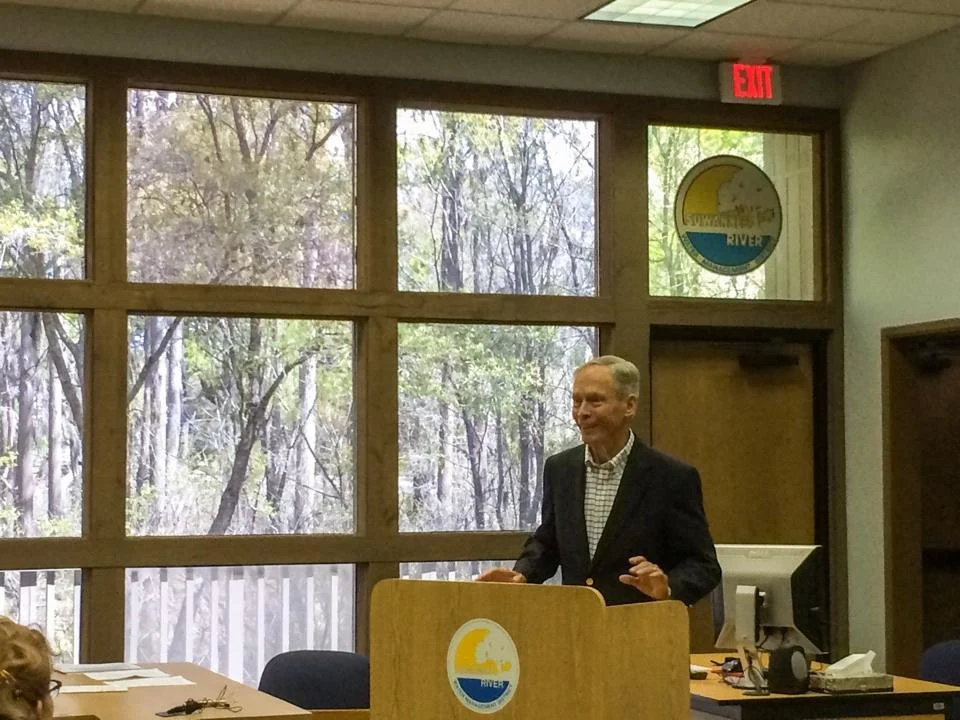
Consider this idea from former Florida Governor Buddy MacKay Jr., published in the Gainesville Sun: “Give Florida springs consumptive-use permits with priority rights over existing holders of consumptive-use permits. If new permits are issued, reduce existing consumptive-use permits proportionately, until flows to the springs are restored. Assuming an existing shortfall of 20 percent, all existing consumptive-use permits should be reduced by 20 percent until the minimum flows are restored.”
-
STRONG STATEWIDE REGULATION AND ENFORCEMENT OF BOTH POINT- AND NON-POINT SOURCES OF POLLUTION to ensure that our fouled waters are cleaned up. Governments must implement ways to move people off septic tanks and onto sewer systems. We must stop using our waters as sewers for human and animal waste, and we must greatly reduce the amount of fertilizer we use. If we don’t, it’s only a matter of time before we face a public health crisis caused by fouled drinking water. [6]
This requires:
– Reducing the amount of nitrogen and phosphorus leaching into the aquifer. Begin by following the lead of other aquifer-sensitive regions that place a limit on fertilizer use, improve wastewater treatment and disposal practices, and relocate land use practices that are unsuitable for the area.
The right place for crops that require nitrogen fertilizers and animals farms that produce high levels of waste is somewhere other than our highly vulnerable karst springsheds. Consider relocating these farms to areas where the aquifer is “confined,” which means more shielded from direct pollution by thick layers of clay. There is an historical precedent for this. In the 20th century, dairy farms were relocated from South to North Central Florida to eliminate their pollution burden on the Everglades. Now we need to relocate them again, outside springsheds and places where the aquifer is unconfined and therefore vulnerable.
In areas of unconfined karst, for example in the Santa Fe springs basin, we need to reduce the nitrogen fertilizer applied by >50%. This would require everybody – both residential and agricultural sources – to reduce the amount of fertilizers they use. Clearly, the first step should be to eliminate the use of nitrogen fertilizers for lawns and landscaping. The remaining reduction will need to be equitably spread over the agricultural landscape.
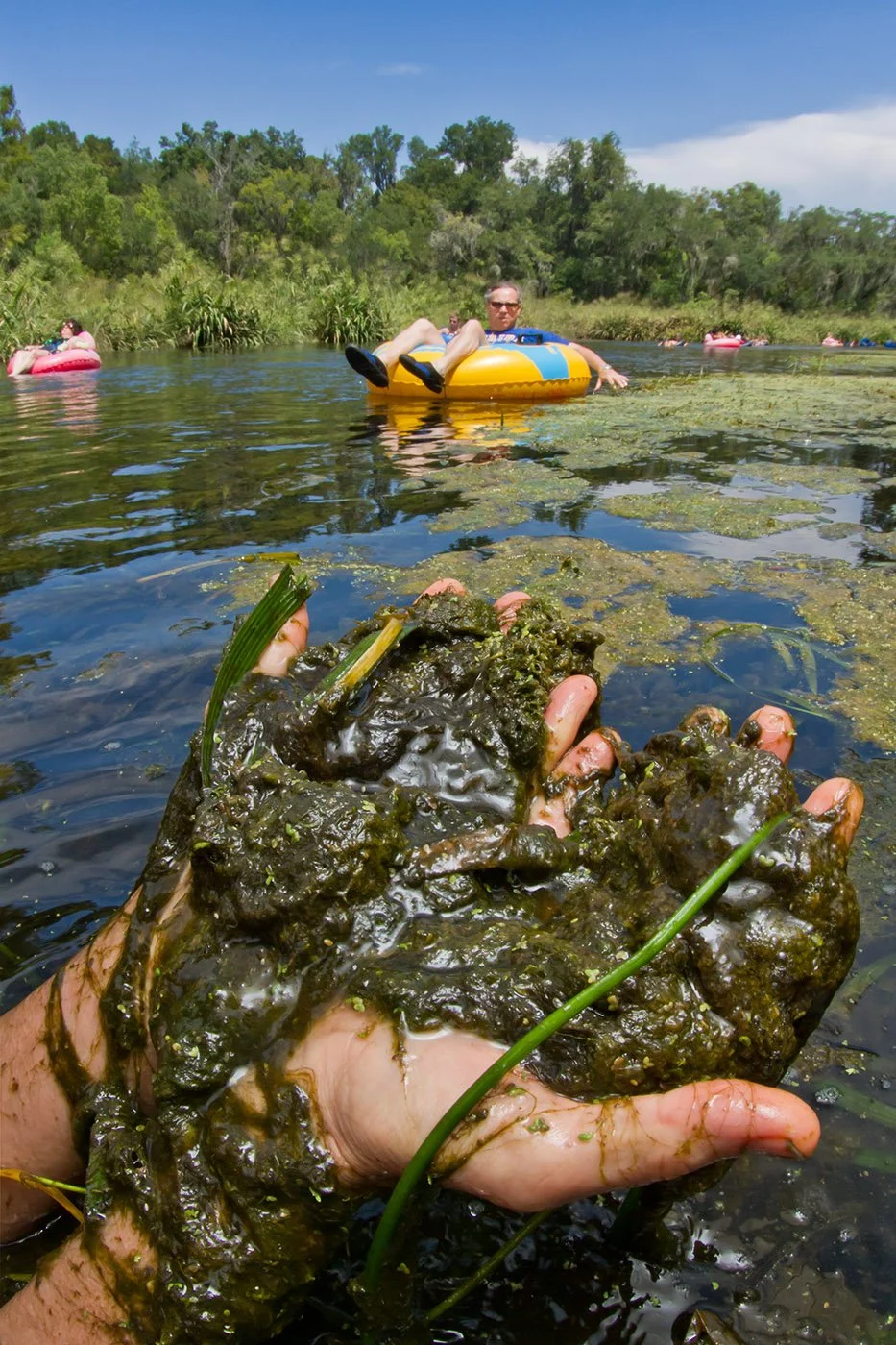
We need restrictions on nitrogen fertilizer sales and use in sensitive karst areas of springsheds, based on application rates that will result in measurable declines in groundwater nitrate nitrogen concentrations. [7] Remember, the background nitrogen level for Florida springs was .05 ppm (parts per million). A healthy spring system can only tolerate .3-.35 ppm. Today, the nitrate nitrogen levels in many of our algae-choked springs far exceed that limit.
We need to offset land uses which contribute more than 1 K of nitrate per hectare by setting aside large areas of land dedicated to forest or other use which uses no groundwater and no fertilizer. (Robert Williams, attorney for the Center for Earth Jurisprudence)
We need to adopt the principle that the polluter pays across the board. Agricultural interests dump 1,500,000 tons of nitrate fertilizer onto the land every year. This needs to be taxed at a rate which is sufficient to cover the cost of clean-up. Similarly, large water users need to pay for the water they take out of the aquifer and that money should be spent to preserve or restore the land’s recharge capabilities. (Robert Williams, attorney for the Center for Earth Jurisprudence)
Recommendations by the Florida Conservation Coalition:
–More Effective Total Maximum Daily Load (TMDL) and Basin Management Action Plan (BMAP) Implementation and Enforcement. The current TMDL and BMAP process has proven ineffective in reducing nitrates and pollutant loading to our water resources, primarily because they are not being effectively implemented. The attitude persists that more studies are needed to address these issues. Perhaps in some circumstances more detailed studies are needed, but it is not a lack of information or studies that is causing the degradation of our springs and water resources. [8] The issue here is a lack of political will to enforce laws already on the books.
–Improve Effectiveness and Enforcement of Agricultural Best Management Practices. Under the current BMAP process, agricultural best management practices are voluntary and largely focused at lowest common denominator-solutions that do little to help achieve the state criteria for water quality in our springs. In areas where agricultural practices are shown to be a significant source of springs deterioration Florida Department of Agriculture and Consumer Services (DACS) needs to create, monitor, and enforce Best Management Practices that result in the reduction of nitrates in Florida’s springs within the shortest possible time frame. Best Management Practices should have specific goals for nitrate loading on a site-by-site basis, mechanisms for monitoring to assure the achievement of these goals, and an enforcement system to ensure that these goals are met. [9] We need Best Management Practices that focus on what’s best for our water and our future, and not just what’s best for short-term agricultural profits.
– Reduce Septic Tank Pollution– Years of scientific research have identified septic tank discharges as a major source of water pollution throughout much of Florida, particularly in areas of the state containing most of Florida’s springs. Even properly maintained septic tanks contribute large amounts of nitrates to the Floridan Aquifer and springs, yet many septic tanks are not properly maintained because of the perceived inordinately high cost of inspections and maintenance. Given the difficulties of inducing private action to address this problem, and the reality that even well-functioning septic tanks contribute unacceptable nitrate levels to our groundwater, legislation is needed to authorize state and local governments to require and enforce the removal of septic tanks, and to provide the funding to replace septic tanks with central sewer systems and advanced wastewater treatment facilities. Regional nutrient reduction strategies, including comprehensive management entities to coordinate all types of wastewater treatment, are also necessary.
The Clean Water Act provides Florida with financing for sewage treatment infrastructure under the State Revolving Fund, a low-interest loan program administered by the U.S. Environmental Protection Agency and Florida Department of Environmental Protection. Federal, state and local government sewage treatment funding that currently facilitates growth and sprawl would be better directed to ensuring our state has the necessary infrastructure to support current and future Florida residents and businesses without damaging water and natural resources. Local governments within priority springsheds should be given discretion to adopt stricter standards for septic tanks for both new and existing onsite sewage treatment systems. [10]
–Reduce Fertilizer Pollution – Fertilizer use is a major source of water pollution throughout Florida, affecting nearly every important water resource in Florida. Unfortunately, local governments that have enacted regulations on fertilizer are finding themselves in conflict with the Legislature, which has sought to prohibit or weaken such regulations. It is not scientifically feasible to restore our springs and protect our waters without meaningful and effective fertilizer regulations that apply to large agricultural operations and other significant users, including residential users. Many agricultural operations could be covered under an improved BMP program. The legislature should take a leadership role and establish strong statewide regulations for fertilizers sold in Florida and provide stronger minimum criteria for utilization in Florida. Whether agricultural or residential, state legislation should allow for more stringent local requirements. [11]
-
Connect Water Quality and Water Quantity Regulations. Florida has two distinct regulatory systems for dealing with water quality and water quantity issues. This separation fails to reflect the undeniable linkage between these two important areas. Reduced spring and river flows serve to concentrate pollution that would otherwise be diffused if more water were running through our spring systems. In that regard, Chapters 373 and 404 of the Florida Statutes need to be linked together so Florida’s water management districts can consider the effect of increased nutrients and pollution when making consumptive use permitting decisions. Under the existing system, even if a water management district is aware that approving a consumptive use permit will result in increased nutrient levels, even beyond criteria established by the state, they are unable to incorporate this knowledge into their permitting decisions. Florida’s regulatory agencies need the authority and tools to address both water quality and quantity problems in order for real progress to be made. The districts should also proceed to develop water reservations for all stressed spring and river systems as already required by Chapter 373. [12]
–Standards for Groundwater Discharges. Permits issued for discharges into the aquifer should be evaluated and modified to assure that they do not cause or contribute to violations of surface water standards once the water resurfaces in Florida’s springs. It is essential that our laws and regulations reflect the direct connection between groundwater and surface waters. Dye tests like those performed in connection with Wakulla Springs (Wakulla County) show that groundwater can travel much faster through karst areas of the aquifer than previously thought, reducing the ability for nutrients and other pollution to be filtered out before reaching springs. Updating central sewage treatment nutrient output standards in priority springsheds should be given the highest priority. [13]
–Update Water Management District Rainfall and Recharge Modeling. Water management districts currently use outdated rainfall models that overestimate annual rainfall amounts in their consumptive use permitting process. Assuming that present and future rainfall will mimic that of the past (but which is often less than in the past), results in the permitting of greater withdrawals than would otherwise be allowed. The consequence of this system of management has resulted in the continued drawdown of the Floridan Aquifer at a rate greater than it can be replenished, leading to reduced spring and river flows and lower lake levels. Florida’s water management districts should update rainfall models to reflect actual rainfall totals and trends over the recent past. This is ofspecial importance considering that water management districts have argued that reduced spring and river flows are the result of decreased rainfall, yet, at the same time, do not acknowledge the same decreases in their consumptive use permitting decisions.
In addition, water management districts should revise aquifer recharge models to reflect the alteration of land uses that have led to greater run-off and reduced aquifer recharge even during times of heavy rains. [14]
See a pdf of Dr. Todd Kincaid’s groundwater model, (large file, takes a while to download) for a better solution to the current model. Let’s require our WMDs and DEP to adopt the more accurate karst-based model and demand that our Florida legislators apportion our tax dollars to properly fund it.
–Annual Report – The DEP should annually submit to the Legislature and Governor an assessment of the water quality and flow and level conditions of springs and significant water resources, using 2013 conditions as the baseline. A report in 2014, the baseline report, and annual reports beginning in 2015 should include: for springs – clarity, nitrate and pollutant concentrations (including the sources), algae, and biota; for significant water resources – water levels and flow and nutrient and pollutant concentrations (including the sources); and for groundwater – ground water levels, principal water users, and nutrient and pollutant concentrations in the watersheds or areas related to or affecting springs and significant water resources. The report should also detail the individual and cumulative effects on water quality and quantity of projects completed after 2013. [15]
–Water Management District Governing Board Selection. In 1997, the Legislature required the consideration of diversity in water management district governing board composition and expertise. Unfortunately, simply mandating “consideration” has proven ineffective at assuring diverse and knowledgeable governing boards that represents the public’s best interest. The Legislature should consider a more specific directive to ensure that its intent is carried out. One solution would be to institute a nominating system (with a candidate screening committee) similar to that used in appointing Public Service Commissioners. This would result in a more balanced list of potential appointees. Specific guidance should be given to the screening board to include representatives from the business, agricultural, academic and environmental communities. [16]
–Re-evaluate public recreational uses in all springs on Florida public lands to develop science-based management plans that insure compatibility between appropriate recreational activities and sustainable ecological communities in these “crown jewels” of our parks, preserves, and national forests.
-
With respect to governance, we need to declare that OUR GROUND WATER IS A PUBLIC TRUST and make sure that the state agencies to regulate the ground water have a fiduciary duty to protect that trust. (Robert Williams, attorney for the Center for Earth Jurisprudence)
-
![Center pivot irrigation spraying water across a field, creating a rainbow over a roadside landscape.]()
Florida Water Budget
Center pivot agricultural irrigation wastes water, particularly through evaporation. Photo by John Moran
-
![Former Florida Governor Buddy MacKay Jr. speaking at a public meeting in a conference room.]()
Former Florida Governor Buddy MacKay Jr.
Former Florida Governor Buddy MacKay Jr. eloquently explaining the original intent of the 42 year old Minimum Flows and Levels rules at the Suwannee River Water Management District hearing on April 2, 2014.
-
![Lucinda Merritt speaking at a water management district meeting with attendees seated in the room.]()
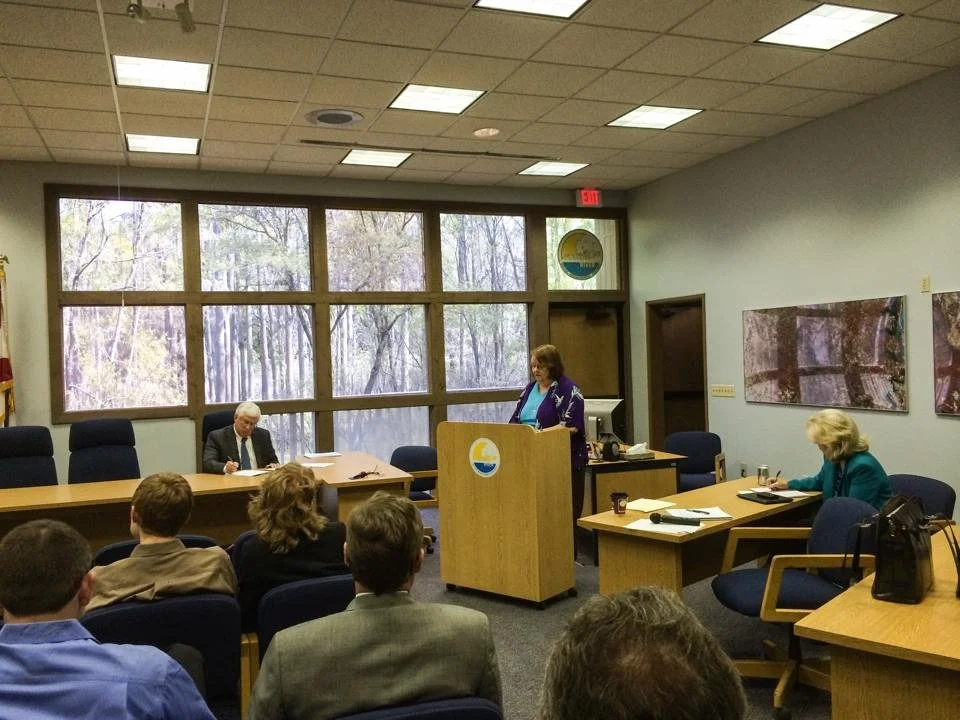
Lucinda Merritt
Lucinda Merritt calling for mediation after the proposed MFL rule for the Lower Santa Fe and Ichetucknee rivers was radically rewritten (under FDEP influence) to be far less protective of the rivers. Suwannee River Water Management District hearing on MFLs, April 2, 2014.
-
![Hand holding thick green algae collected from spring water.]()
Ichetucknee Algae
Photo by John Moran
-
![Clear spring run bordered by lush vegetation and aquatic plants visible beneath the water surface]()
Crystal Clear Waters
Photo by Wes Skiles
-
![Cave divers swimming through an underwater aquifer passage with rock formations and submerged tree roots visible]()
Cave Divers Entering the Aquifer
Photo by
-
![A cave diver shines a light while entering the clear waters of a Florida spring, with sunbeams streaming through the water onto eelgrass and limestone below.]()
Diver in the Spring
Photo by Mark Long